

Caring for black pepper plants during their initial growth phase—from 0 to 3 years—is crucial for establishing healthy vines and achieving high yields in the long run. During this period, proper shade management, watering, weed control, pruning, and soil care play a significant role in ensuring the plant’s vigor and resistance to common diseases like foot rot.
How to protect black pepper vines after planting?
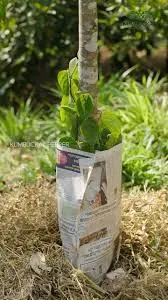
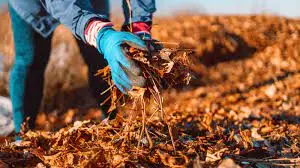
Protect the young vines from hot sun during summer by providing artificial shade. Cover the young plants with dry arecanut leaves, coconut leaves or twigs of trees until summer months are over. Mulching the basins of pepper vines during summer months with saw dust, arecanut husk and dry leaves is also recommended.
Pepper garden should be well drained. Water logging is harmful for pepper plant and high humidity may promote the incidence of foot rot disease. Carry out digging around the standards and vines at a radius of about 1 meter from the base or in the entire plantation, twice during the year, the first at the onset of southwest monsoon and the second towards the end of northeast monsoon. However, in foot rot affected gardens, digging should be avoided and weeds removed by slashing. In the early stages, tie the vines to the standards, if found necessary.
Weeding and Mulching
Two to three rounds of hand weeding are recommended in a year to control weeds. During weeding, plant base should not be disturbed causing injury to the root system. Only slash weeding is recommended.
Where pepper is grown in large areas, growing of cover crops like Calapagonium mucunoides is recommended. When such cover crops are grown, they are to be cut back regularly from the base of the plants to prevent them from twining along with the pepper vines. Lowering of vines after one year’s growth will promote lateral branch production.
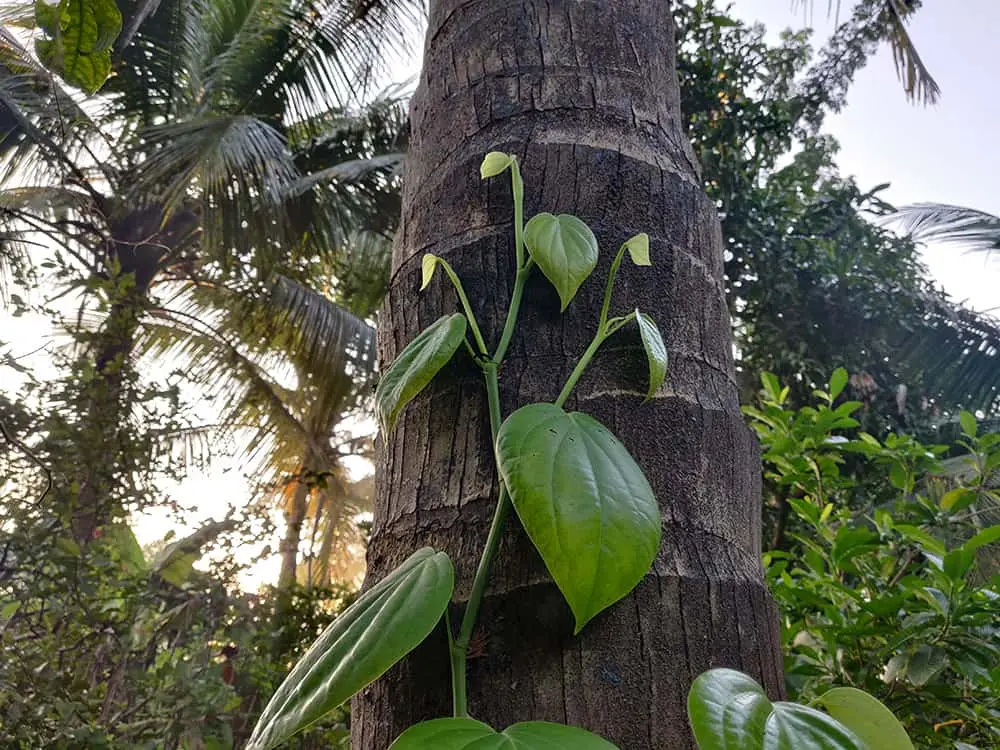
Removal of unwanted terminal shoot growths and hanging shoots should be done as and when necessary. If the terrain of the land is sloppy or uneven, contour bunding or terracing should be carried out to prevent soil erosion.
How to Fertilize your black pepper plants?
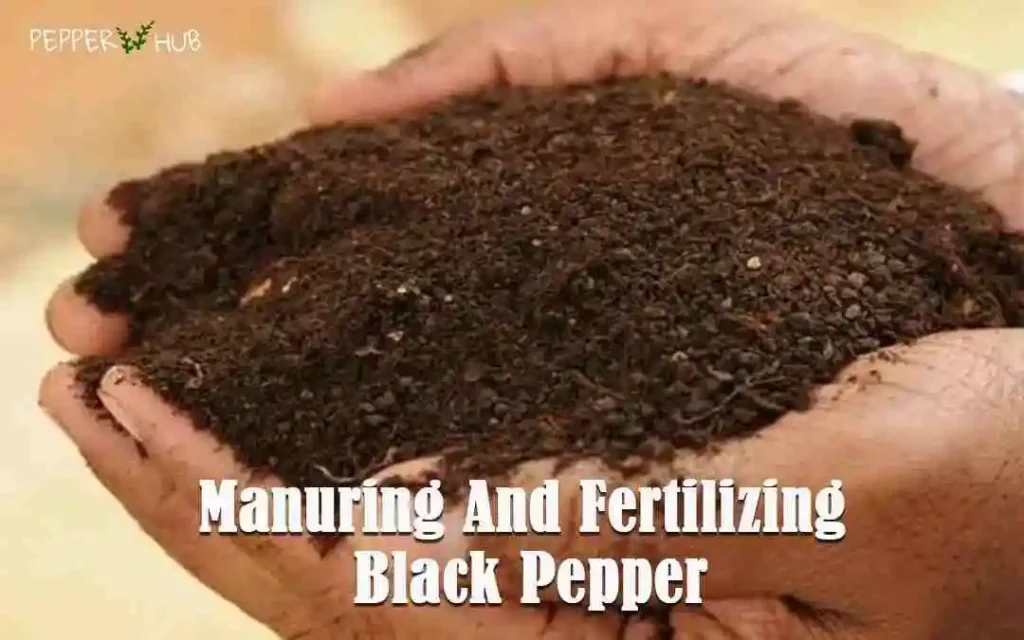
Apply cattle manure, compost, or green leaves at the rate of 10 kg per plant per annum just at the onset of the southwest monsoon and cover lightly with soil. Lime or dolomite has to be applied in acid soils two weeks ahead of fertilizer application. The recommended dosage is 500 grams per vine in alternate years. Fertilizers should be applied at a distance of about 30 cm all around the vine and covered with a layer of soil. Care should be taken to avoid direct contact of fertilizers with the roots of the pepper vine. Fertilizer should be applied only when there is sufficient soil moisture.
Can Intercropping be done for black pepper plants?
Intercropping of pepper gardens with ginger, turmeric, colocasia and elephant foot yam is advantageous. Banana should be grown only in the initial years.
What is the correct way to water black pepper vines after planting?
Black pepper trailed on standards should be irrigated with 8–10 litres of water per day through drip between October to March. If a drip system is not in use, application of 100 litres of water per vine once a week from October to March is necessary. Prune and train the standards in March–April every year to remove excessive overgrowth and to give them a proper shape. The standard’s effective height is limited to about 6 meters. A second pruning of the standards may be done in July–August, if there is excessive shade in the garden.
Underplanting should be attempted at about 20 years after planting or when a regular declining trend in yield appears. The old and senile vines can be removed 3–5 years after under planting, depending upon the growth of the young vines. In case of bush pepper, the bushy nature of the plant will have to be ensured by proper pruning of the viny growth. The potted plants are to be kept preferably under partial shade. Re-potting must be carried out every two years.