

1.Manganese deficiency in Black Pepper Plants
Symptom
Manganese deficiency symptoms are more severe in the upper canopy of affected plants. Younger leaves turn chlorotic or yellowish white with only the main veins remaining green.
The older leaves produce a characteristic herringbone pattern with green veins and the areas between the veins turn yellowish white. At a later stage, small necrotic spots appear and grow in size in the pale areas. When deficiencies are prolonged and severe, berries also show characteristic symptoms.
Management
Kerala soils in general have high levels of manganese. High amount of iron may induce magnesium deficiency.
Go for soil testing to understand the real reason for the problem. In deficient soils, apply Manganese Sulphate (5 gram/liter of water) as foliar spray.
2.Iron deficiency in Black Pepper plants
Symptom
Iron deficiency begins in the younger branches and is characterized by interveinal chlorosis. The chlorosis occurs in between the main veins and smaller veins as well, forming a fine reticulate pattern of green veins contrasting sharply with a pale green or yellow background. The youngest leaves may be completely green or even white.
In acute deficiency, the inter-nodal length of terminal shoots and lateral branches is markedly shortened and leaves tend to crowd together at the upper end of the canopy. The berries of affected vines appear pale green to yellow.
Management
Iron deficiency is strongly associated with calcareous soils, anaerobic conditions, and it is often induced by an excess of heavy metals. Good drainage and soil aeration favors iron availability.
Low levels of potassium can increase iron deficiency. Kerala soils in general are high in iron. So go for soil testing to understand the real reason for the problem. In deficient soils, apply Ferrous Sulphate (60 gram/cent or 6 kg/acre) into the soil.
3.Boron deficiency in Black Pepper Plants
Symptom
Boron is an immobile element in plant. Hence, boron deficiency is seen mainly in growing points, younger leaves and developing fruits.
Boron deficient plants are stunted with shortened internodes and reduced branching. Young leaves are small and distorted with pronounced puckering and necrotic lesions on the main veins. Reduced size of berries.
Management
Boron deficiency is seen more in dry soils. High available phosphorous in soil also hinders boron absorption. Go for soil analysis and confirm the deficiency. Apply Borax (40 gram/cent or 4 kg/acre) into the soil. For immediate result spray Borax (1 gram/liter of water) as foliar spray. Excess concentration may result in toxicity.
If calcium and boron have to apply simultaneously, apply calcium in soil and boron as foliar spray. Foliar spraying should be done during morning hours. The best stage of application is just before flowering. Similarly, borax should not be applied with ammonium fertilizers.
4.Magnesium deficiency in Black Pepper plants
Symptom
Magnesium deficiency symptoms first appear on older leaves and progress to younger leaves. In the early stage, chlorosis occurs in between main veins. This usually starts from the central proximal half of the leaf. The chlorotic area enlarges to the leaf tip and subsequently towards the leaf margin.
A light dramatic leaf fall is often induced, leaving the branches quite bare with only younger unaffected leaves remaining on the plant. The area near the petiole often stays green and gives an arrowhead effect of green tissue penetrating the yellowing areas on the leaf. Common at berry maturing stage.
Management
Go for soil analysis and confirm the deficiency. Apply Magnesium sulphate (320 gram/cent or 32 kg/acre) in bands near plants.
Application of dolomite will also reduce magnesium deficiency in long run. However, magnesium and potassium fertilizers should not be used together.
5.Calcium deficiency in Black Pepper Plants
Symptom
Calcium deficiency is first observed in fresh mature leaves as yellowing or chlorosis which starts on either or both edges near to the petiole end or middle part of the leaf blades. The marginal chlorosis advances inward, followed by necrosis. The proximal and distal ends of the affected leaves are either green or pale green.
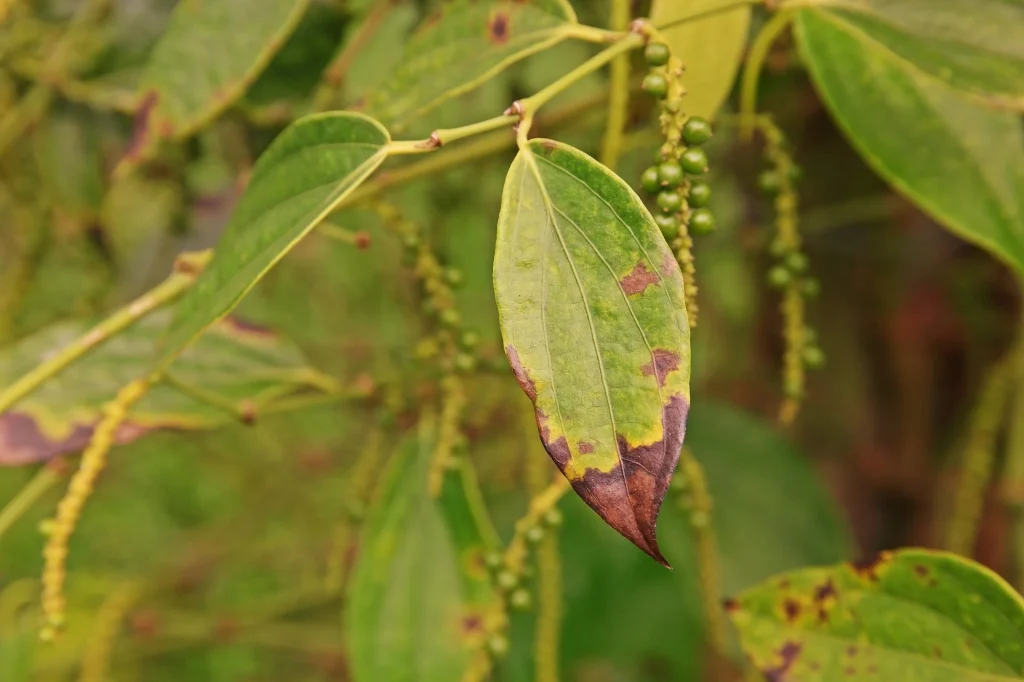
Tiny pinhead necrotic spots may appear scattered between the main veins on the lower and upper surfaces of the leaves. Leaf abscission occurs before the central portion of the leaf becomes necrotic. Die-back may occur at the growing point. Leaves of the lower canopy are usually more severely affected than those of upper canopy. Short internodes, leathery leaves.
Management
Check the pH of the soil. If the soil is extremely acidic (pH between 3.5 and 4.5), apply lime (3.4 kg/cent of 40 m2 in two split doses). And in areas of moderate acidity (pH between 5.5 and 6), apply lime (1 kg/cent of 40 m2).
Dolomite can be used as cheap substitute of lime.
High levels of phosphorous can also induce calcium deficiency. In alkaline soil go for application of Gypsum. Calcium has little mobility in the plant; hence its availability has to be ensured all the time. Boron is needed for calcium utilization. So a boron deficiency can also lead to calcium deficiency.
6.Potassium Deficiency in Black Pepper Plants
Symptom
Potassium is a highly mobile element in plant. So the deficiency symptoms will be first noticed in older and lower leaves. The deficiency symptoms can be seen on the distal end of affected mature leaf blades. They become necrotic, brittle and grey in colour.
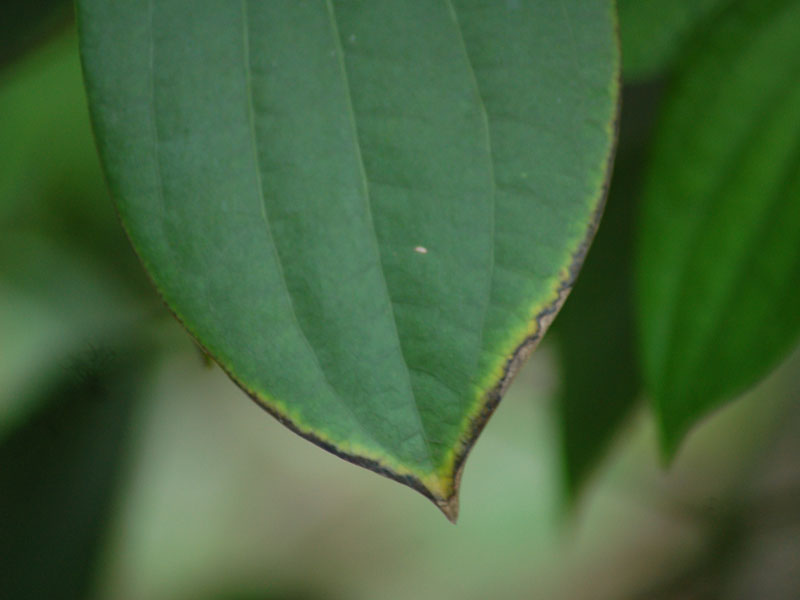
Necrosis is usually confined to the distal end, while the portion beyond the boundary separating necrotic and live tissues displays a ‘V’ shape band, which is yellow to reddish brown. This band sometimes occurs without the ‘tip burn’ symptom.
Management
Optimum availability of potassium is at soil pH above 6.0. So correct soil pH in acidic soils by adding lime/ dolomite. Add organic matter and wood ash to the soil. Add bio fertilizers containing potash mobilizing bacteria to release non exchangable potassium from soil. Check whether the recommended quantity of potash fertilizer is applied in time.
Go for soil analysis and understand the extent of deficiency. Apply Muriate of Potash (MOP) as per soil test report. Split application is more beneficial. As an immediate solution apply Sulphate of Potash (SOP) as foliar spray (10 gm /liter of water) during morning hours along with wetting agents.
7.Phosphorous deficiency in Black Pepper Plants
Symptom
Clear symptoms of Phosphorus deficiency often rare in the field. In severe cases, the most striking symptom is stunted growth of the plants. This effect is not because of reduced terminal growth, but because of restricted lateral growth due to poor secondary branching.
Leaf blades of mature leaves become very dull looking, turn bronze coloured, tend to be stiff and show necrosis at the tips. Older leaves wither and die early. Plants with a severe deficiency of phosphorus frequently have thinner stems. The root growth is also restricted. Stunted root growth and lack of healthy roots.
Management
Phosphorus is best absorbed by the roots in the pH range 6.2-7.0. So adjust pH in acidic soils by adding lime. An excess of Iron and Zinc may also cause the symptoms of phosphorus deficiency.
Go for soil analysis and understand the extent of deficiency. Apply fertilizers such as single superphosphate for immediate correction or bone meal or rock phosphate for slow correction at the recommended rate.
8.Nitrogen deficiency in Black Pepper Plants
Nitrogen is a highly mobile element in plant. So when the soil become deficient in available nitrogen, nitrogen from lower leaves will get transferred to growing points. Hence, deficiency symptoms will be first noticed in older and lower leaves. The symptoms are generally characterised by poor growth, with pale and yellowish leaves.
At first, the lower leaves turn yellowish but the upper canopy of affected plants tends to remain relatively green. In severe cases, leaves of the entire plant show a characteristic yellow to orange-yellow discolouration and the
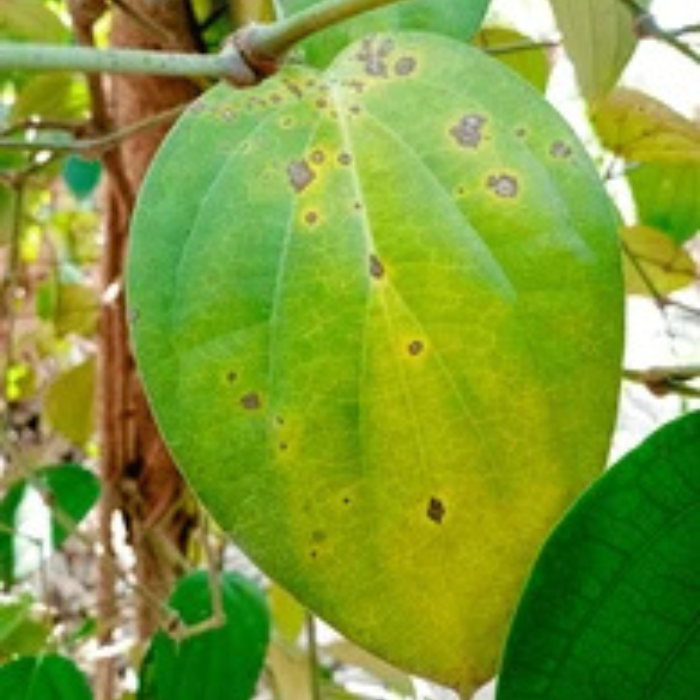
extreme end of the leaf tip becomes necrotic in some instances. Leaf abscission is common in severely affected plants. Symptom appears when the plant starts flowering.
Management
Add sufficient quantity of organic matter with Trichoderma to the soil every year. Add bio fertilizers like Azospirillum. Check whether the recommended quantity of fertilizers is applied in time. Go for soil analysis and understand the extent of deficiency.
Apply quick release nitrogen fertilizers like urea as per soil test result in split doses. As an immediate solution applies urea as foliar spray (10 gram/liter of water) once in 15 days till the deficiency is over. Application of organic growth promoters at frequent interval is also advantageous.
Know more about Other diseases in Black Pepper?
This article is a valuable resource for anyone cultivating black pepper. Understanding deficiency disorders and their symptoms is crucial for timely intervention and healthy yields. The clear breakdown of nutrient roles and visual cues makes it especially helpful for farmers and agri-enthusiasts alike.