
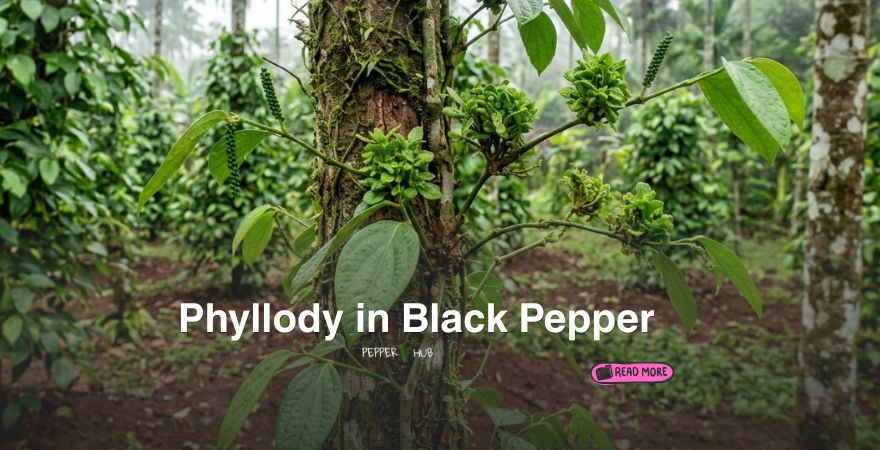
Phyllody is the strange thief that steals the black pepper plant’s productivity. It is one of the most visually bizarre diseases in the spice world, transforming a high-yielding vine into a mass of unproductive, leafy tangles.If your black pepper spikes are looking more like miniature bushes than peppercorn clusters, you’re likely dealing with Phyllody.
What is Phyllody?
Phyllody is a disease where the floral parts (the flowers and spikes) are abnormally transformed into leaf-like structures. Instead of developing into spicy berries, the plant produces clusters of small, distorted green leaves.
The culprit isn’t a fungus or a bacteria in the traditional sense; it is caused by Phytoplasmas. These are specialized bacteria that lack cell walls and live within the plant’s phloem (the “veins” that transport sugar).
Key Symptoms to Watch For
The symptoms of Phyllody are unmistakable once they appear
•Floral Transformation: The most striking sign. The pepper spikes, which should hold berries, grow into branched, leafy structures.
•Witches’ Broom: The vine produces an excessive number of small, crowded shoots at the nodes, giving the plant a “bushy” or “bunchy” appearance similar to a broom.
• Stunting: Infected vines often show shortened internodes (the space between leaves), leading to a stunted, compact growth habit.
•Sterility: Because the flowers have turned into leaves, the vine becomes partially or completely sterile, leading to a total loss of yield on the affected branches.

How is it Spread?
Phytoplasmas cannot move on their own. They rely on “taxis” to get from one plant to another:
- Insect Vectors: Tiny sap-sucking insects, primarily leafhoppers, carry the phytoplasma from infected wild plants or neighboring pepper vines and inject it into healthy tissue while feeding.
- Vegetative Propagation: This is the most common way the disease spreads across farms. If a farmer takes cuttings from a vine that is unknowingly infected, the new plant will carry the disease from day one.
Management Strategies
There is no “cure” for a vine once it is systemically infected with phytoplasma. Therefore, management focuses on stopping the spread.
- Start Clean
The most important rule is to never take cuttings from a vine showing even slight symptoms of bushy growth or floral distortion. Always source planting material from certified, disease-free plant nurseries. - Rogueing (Removal)
If you spot a vine showing symptoms of Phyllody:
• Remove it immediately: Uproot the entire vine, including the root system.
• Destroy it: Burn the infected material away from the plantation to ensure insect vectors don’t pick up the pathogen from the wilted remains. - Vector Control
Since leafhoppers spread the disease, keeping their population in check can slow down the transmission.
• Maintain a clean plantation by removing weeds, which often serve as alternative hosts for both the insects and the phytoplasma.
• In cases of high insect activity, use neem-based sprays or recommended systemic insecticides to deter sap-sucking pests.
Phyllody might not kill your vine, but it renders the black pepper plant a “zombie”—alive, but useless for production. Routine scouting of your pepper garden during the flowering season is essential to catch this strange transformation before it spreads through your entire crop.
Have you noticed “bushy” growth on your black pepper vines? It might be time for a closer look at your spikes.
Read more about Black Pepper Cultivation