
Maximizing your microgreen yield isn’t just about planting more seeds; it’s about optimizing the environment so every tiny stem reaches its full potential. Whether you’re growing for your own kitchen or starting a small business, fine-tuning your process can lead to a denser, heavier, and more nutritious harvest.
How to make microgreens grow faster?
1. Optimize Your Seeding Density
The most common mistake beginners make is sowing seeds too sparsely. To maximize yield, you want a carpet of greens, not a few scattered stems. For a standard 10×20 tray, aim for the “sweet spot” where seeds are touching but not overlapping. Generally, this means 25–35 grams for small seeds (like broccoli or kale) and 80–100 grams for large seeds (like peas or sunflowers). If you can see a lot of bare soil after sowing, you’re leaving yield on the table.
2. Master the “Blackout” Phase
After sowing, cover your trays with another tray or a weighted lid for 2 to 5 days. This is known as the blackout phase. By adding a small weight (about 2–5 lbs) on top, you force the seedlings to push upward, which strengthens their stems and ensures uniform germination. This extra struggle actually creates a heartier, heavier crop once they are finally exposed to light.
3. Use High-Intensity Lighting
Once the blackout phase is over, your micro greens need a lot of light to prevent them from getting “leggy” (thin and weak). Use LED grow lights with a color temperature between 5500K and 6500K. Aim for a photoperiod of 16 to 18 hours of light per day. Placing your lights about 6–12 inches above the trays ensures the plants get enough energy to develop thick, heavy leaves rather than just stretching for the sun.
4. Switch to Bottom Watering
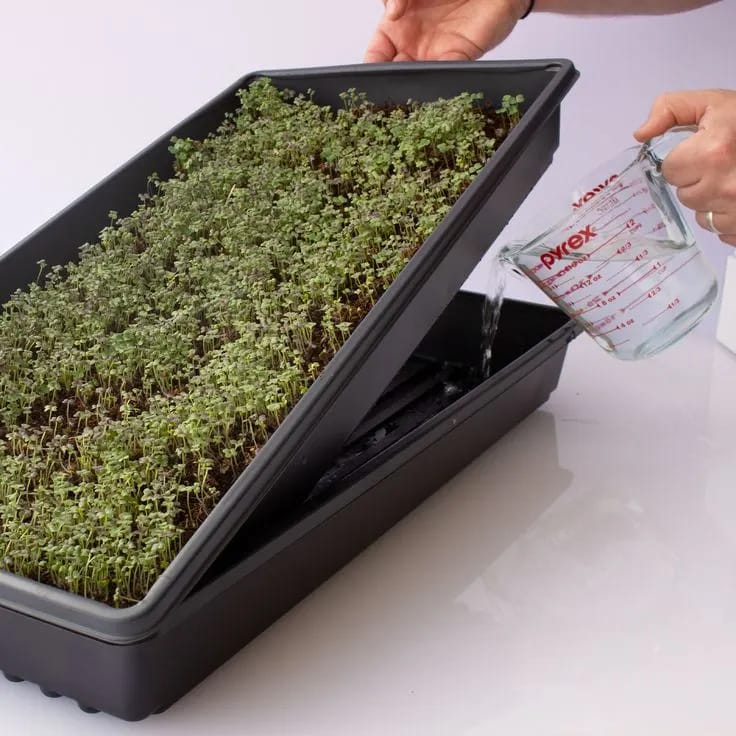
Watering from above can flatten your delicate greens and trap moisture in the canopy, leading to mold and rot—the ultimate yield killers. Instead, use a two-tray system (one with holes, one without) to water from the bottom. This encourages the roots to grow deep and keeps the stems dry. Dry stems mean less disease, allowing you to grow your crop for an extra day or two for maximum weight.
5. Control Temperature and Airflow
Microgreens thrive in a “Goldilocks” environment: not too hot, not too humid. Keep your grow space between 65°F and 75°F and maintain humidity at 40–60%. Stagnant air is an invitation for mold, so use a small oscillating fan to keep air moving. Good airflow strengthens the plant cell walls, resulting in a more robust harvest that stays fresh longer after cutting.
6. Time Your Harvest Perfectly
Yield is a balance between height and flavor. Most varieties reach their peak weight just as the first “true leaves” begin to emerge. Harvesting too early means losing out on biomass, while waiting too long can make the greens bitter or tough. For most brassicas, this is around day 10–14. Use sharp scissors or an electric knife to cut as close to the soil line as possible (without grabbing dirt) to capture every gram of growth.
Pro-Tip: If you’re growing in a nutrient-poor medium like coco coir or jute mats, adding a very dilute, organic liquid fertilizer to your bottom-watering routine after day 7 can boost your final weight by up to 20%.