
Did you know that you can develop large number of plantlets using different methods of plant tissue culture?
Agriculture, the backbone of human sustenance, has evolved significantly with technological advancements. Tissue culture, a remarkable innovation, has revolutionized the cultivation practices of various crops, including bananas. This technique is also known as micropropagation. It has proved beneficial for the production of disease-free plants and increase plant yield in developing countries. It only requires a sterile workplace, greenhouse, trained manpower, and a nursery.
Tissue culture banana cultivation have garnered substantial attention due to its disease-resistant, high-yielding, and genetically uniform plants. This blog delves into the fascinating realm of tissue culture banana cultivation, exploring its techniques, benefits, and significance in modern agriculture. Oil palm, banana, eggplant, pineapple, rubber tree, tomato, sweet potato have been produced by tissue culture in the developing countries.
Initiation Phase
Tissue culture involves the propagation of plants under sterile laboratory conditions from selected and healthy plant tissues. At this stage, the tissue is initiated into the culture. Next, the tissue of interest is obtained, introduced and sterilized to prevent the process from any contamination. In the case of banana cultivation, this technique starts with the selection of disease-free and high-yielding banana plants as the source material. Then, small pieces of plant tissue, like shoot tips or nodal segments, are collected and sterilized to eliminate any potential pathogen. Some of the commonly cultivated tissue culture banana plants are Nedunendran and Quintal Tissue Culture banana plants.
Multiplication Phase
Firstly, the sterilized explant is introduced into the medium composed of growth regulators and appropriate nutrients. Consequently, they are responsible for the multiplication of cells. Subsequently, this undifferentiated mass of cells is known as a callus. Following this, the sterilized tissues are then placed in a growth medium containing a precise blend of nutrients, hormones, vitamins, and growth regulators necessary for their growth. With controlled environmental conditions—such as temperature, light, and humidity—these tissues develop into small plantlets. Ultimately, the resulting plantlets are genetically identical to the parent plant, ensuring uniformity in characteristics and traits.
Acclimatization
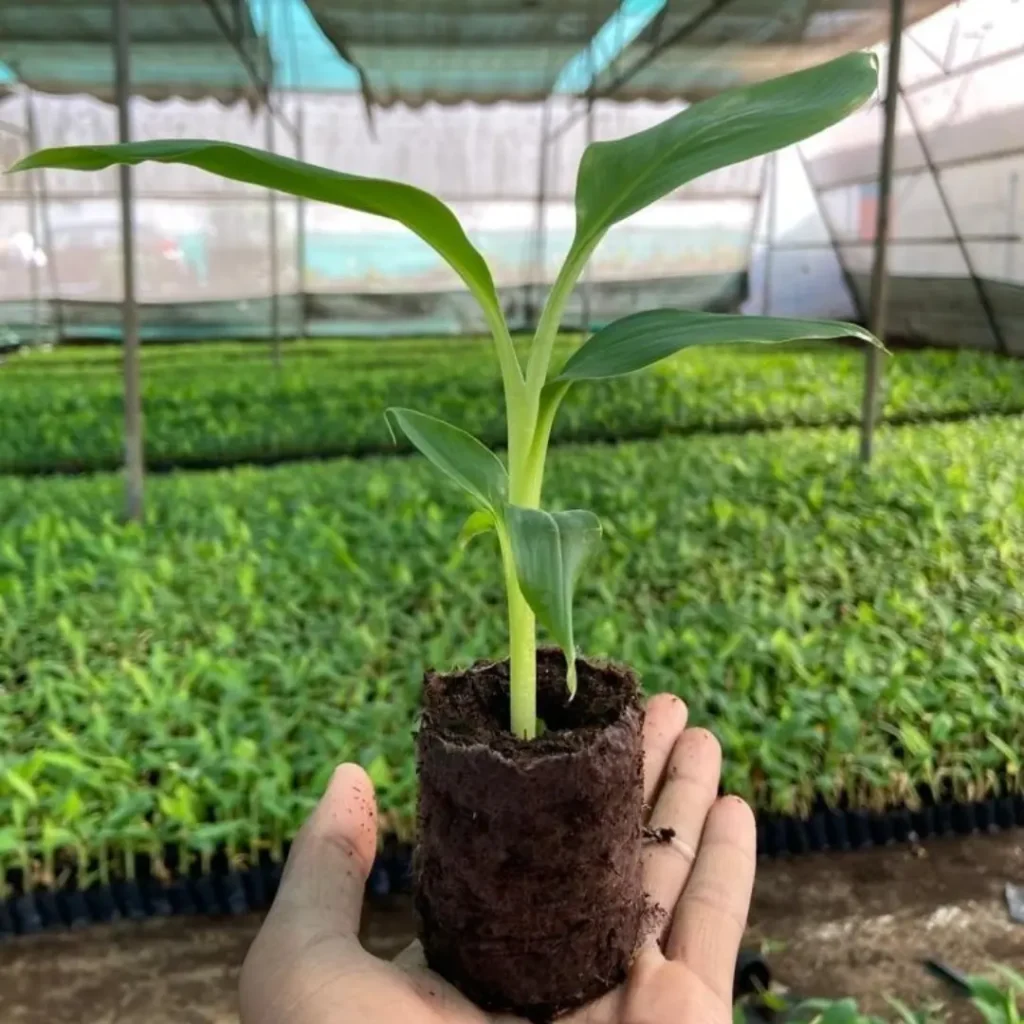
When the plant starts developing, it is transferred to the greenhouse to develop under controlled environmental conditions. It is finally transferred to the nurseries to grow under natural environmental conditions
Advantages of Tissue Culture Banana Cultivation Practices
- Disease Resistance; Tissue culture techniques facilitate the production of disease-free plantlets, minimizing the risk of infections caused by pathogens, viruses, and other detrimental agents commonly affecting banana crops.
- Increased Yield; Through tissue culture, farmers can access high-yielding varieties of bananas. These varieties often exhibit improved productivity, leading to higher crop yields and enhanced profitability.
- Genetic Uniformity; The cloned nature of tissue-cultured banana plants ensures genetic uniformity, allowing farmers to predictably manage and maintain specific traits in their crops, such as size, taste, and ripening characteristics.
- Rapid Multiplication; Tissue culture enables the rapid multiplication of banana plants throughout the year, irrespective of seasonal limitations. This ability to produce numerous plantlets in a relatively short period significantly boosts the availability of planting material.
For all the tissue culture enthusiasts out there, you can try different tissue culture methods for every plant species you work with. You can experiment as you wish and figure out on your own what works best for your plant of choice.
Challenges and Considerations
While tissue culture presents numerous advantages, it also comes with challenges. The initial setup cost for a tissue culture laboratory can be substantial, and the process requires skilled expertise to maintain sterile conditions and ensure successful plantlet production. Moreover, the cost of plantlets produced via tissue culture might be higher initially compared to conventional planting materials.
However, considering the long-term benefits, the investment in tissue culture technology proves worthwhile for farmers due to increased yields, reduced disease incidences, and improved overall crop quality.
Tissue culture banana cultivation practices represent a significant leap forward in modern agriculture, offering solutions to various challenges faced by banana growers. By providing disease-resistant, high-yielding, and genetically uniform plantlets, tissue culture has transformed banana cultivation, ensuring sustainable agricultural practices and enhancing farmers’ livelihoods worldwide.
Can I do tissue culture of Yellakki banana plant at home to save money?
You’ve explained the process of cultivating tissue culture banana plants in such a clear and practical way – it’s really helpful for farmers and learners who want to start modern banana cultivation.
I’ve been creating awareness about tissue culture and guiding young agri-entrepreneurs on how to start with banana micropropagation. Your content aligns perfectly with what I share