
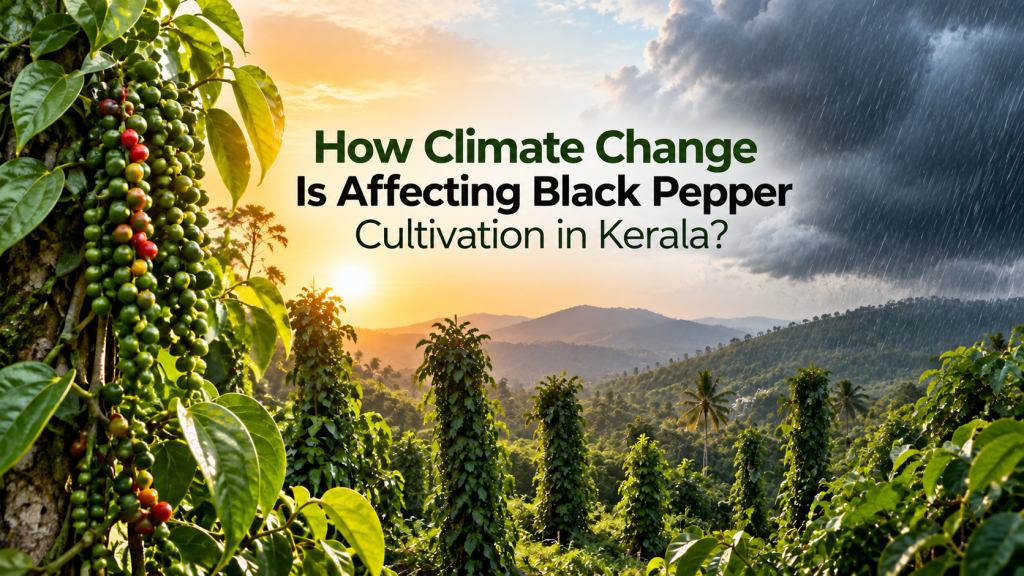
Black pepper has always been closely connected with the climate of Kerala.
Known as the “King of Spices,” black pepper (Piper nigrum) thrives in the warm, humid conditions of Kerala’s plantations. Traditionally, Kerala’s well-distributed rainfall, moderate temperatures, high humidity and shade provided ideal conditions for pepper vines.
But the climate that Kerala’s pepper farmers have traditionally depended on is changing.
Rainfall is becoming more unpredictable, dry spells can occur at critical stages of crop development, intense rainfall events can cause waterlogging and erosion, and temperatures are gradually increasing. These changes can affect flowering, pollination, berry development, soil moisture, pest and disease pressure, and ultimately pepper yield.
Research on black pepper has already identified relationships between climatic variables and productivity. An ICAR study found increasing temperature and declining rainfall trends in several major pepper-growing areas, alongside declining productivity.
While drought is a concern, excessive rainfall can create a completely different set of problems.
Very heavy or continuous rainfall can result in:
- Waterlogging
- Soil erosion
- Nutrient leaching
- Root damage
- Poor aeration around roots
- Weak vine growth
- Increased fungal disease pressure
Black pepper is particularly vulnerable when excessive moisture remains around the root zone.
This is why good drainage is becoming increasingly important for pepper plantations.
A healthy pepper garden should allow excess water to move away from the root zone rather than remain stagnant.
More recent modelling work from Kerala Agricultural University also indicates that climate change could alter the geographic suitability of black pepper in Kerala, particularly under higher-emission scenarios.
So, what exactly is happening—and what can farmers do about it?
Why Is Black Pepper Sensitive to Climate?
Black pepper is a perennial climbing vine that depends heavily on environmental conditions.
It generally performs well under:
- Warm tropical temperatures
- High relative humidity
- Adequate soil moisture
- Well-distributed rainfall
- Partial shade
- Good drainage
- Suitable soil conditions
Research from ICAR-Indian Institute of Spices Research describes black pepper as a crop of the humid tropics, with approximately 2,000–3,000 mm of rainfall generally considered suitable, provided that rainfall is appropriately distributed. The crop is also sensitive to excessive heat and prolonged dryness.
This is important because total annual rainfall alone does not determine pepper productivity.
When the rain falls can be just as important as how much rain falls.
For example, insufficient moisture during important reproductive stages can reduce yield, while excessive rain during flowering can interfere with pollination and create conditions favorable for disease.
Changing Rainfall Patterns Are a Major Concern
One of the biggest climate-related challenges for Kerala’s pepper farmers is not necessarily the complete disappearance of rainfall, but changes in rainfall timing, intensity and distribution.
A farmer may receive substantial rainfall over a short period and then experience a prolonged dry spell. This creates a difficult situation for a rain-fed crop like black pepper.
A study of Kerala’s black pepper-growing regions found that changes in rainfall patterns were among the environmental problems reported by farmers.
What does irregular rainfall mean for pepper?
It can lead to:
- Delayed or irregular flowering
- Poor pollination
- Reduced berry setting
- Moisture stress
- Poor vine growth
- Root stress
- Soil erosion
- Waterlogging
- Increased disease pressure
Therefore, farmers need to pay attention not only to annual rainfall but also to rainfall distribution throughout the crop cycle.
Dry Spells Can Affect Flowering and Berry Formation
Black pepper requires adequate moisture during important stages of flowering and fruit development. A prolonged dry period can cause moisture stress, particularly when soil moisture reserves are already low.
This can affect:
Flowering → Pollination → Berry Setting → Berry Development → Yield
Research on black pepper has found that rainfall during certain periods has a significant relationship with productivity. Earlier ICAR research noted that rainfall during April and May was positively associated with productivity, while rainfall during December and January showed a negative relationship.
This highlights an important point:
More rain does not automatically mean more pepper. The timing and distribution of rainfall matter.
Climate Change Can Increase Disease Pressure
Temperature, rainfall, humidity and the number of rainy days can influence disease development. One of the most serious disease concerns in black pepper is Phytophthora foot rot, while diseases such as anthracnose can also become problematic under favorable weather conditions.
Research on black pepper anthracnose found that rainfall, minimum temperature and the number of rainy days were positively associated with disease incidence.
Earlier research on black pepper also found that weather conditions involving rainfall and high relative humidity can favor Phytophthora disease development.
This means climate change can affect pepper not only directly through heat and water stress, but also indirectly by changing the conditions under which pathogens thrive.
A simple example:
Heavy rainfall + high humidity + poor drainage
↓
More favorable conditions for fungal/oomycete diseases
↓
Root and vine damage
↓
Reduced plant growth
↓
Lower yield
Rising Temperatures Can Stress Pepper Vines
Black pepper prefers warm tropical conditions, but excessive heat and prolonged dryness can become stressful.
Kerala’s climate assessments indicate increasing temperature trends and identify agriculture as vulnerable to climate-related changes. The Government of India’s climate dashboard for Kerala also projects further warming under future climate scenarios.
Higher temperatures can contribute to:
- Increased water loss from plants
- Soil moisture depletion
- Heat stress
- Reduced photosynthetic performance under stressful conditions
- Greater irrigation requirements
- Stress on young vines
The problem can become particularly serious in lowland and hotter regions where temperatures are already higher.
Wayanad and Idukki Need Special Attention
Wayanad and Idukki are among Kerala’s important pepper-growing regions.
Research examining climate and pepper production in these two districts found that climate variables were associated with changes in pepper production, with temperature showing negative effects during certain periods.
Earlier ICAR research also reported declining rainfall trends in Wayanad and increasing temperatures in studied pepper-growing locations such as Ambalavayal.
These findings do not mean that pepper cultivation will disappear from Wayanad or Idukki.
Rather, they highlight the need for better climate adaptation and farm management.
Soil Health Becomes Even More Important
Climate stress can expose weaknesses in soil management.
Heavy rain can wash away nutrients and topsoil, while prolonged dry periods can reduce soil moisture and biological activity.
Healthy soil can act as a buffer against climate variability.
Farmers should therefore focus on:
Organic matter
Adding suitable organic materials can improve soil structure and moisture retention.
Mulching
Mulching helps reduce evaporation and protects soil from direct rainfall impact.
Drainage
Drainage channels can help remove excess water during heavy rainfall.
Soil testing
Regular soil testing helps farmers understand nutrient status and make more informed fertilizer decisions.
Erosion control
In sloping pepper plantations, soil conservation measures can reduce nutrient-rich topsoil loss.
Shade Management Is Becoming More Important
Black pepper is traditionally grown with support trees and benefits from appropriate shade.
However, shade should be managed carefully.
Too little shade can expose vines to:
- Excessive sunlight
- Heat
- Moisture loss
Too much shade can contribute to:
- Poor air circulation
- Excess humidity
- Reduced light availability
- Favorable conditions for certain diseases
Therefore, farmers should aim for balanced shade rather than maximum shade.
Regularly monitoring the plantation can help determine whether support trees need pruning or canopy management.
Water Management Will Become Critical
As rainfall becomes more unpredictable, farmers cannot rely entirely on rain arriving exactly when the crop needs it.
Water conservation can help bridge short dry periods.
Useful practices include:
- Mulching around vines
- Rainwater harvesting
- Farm ponds where suitable
- Maintaining soil organic matter
- Conserving existing water resources
- Providing supplementary irrigation during prolonged dry spells where feasible
The goal is not to irrigate unnecessarily.
It is to retain rainfall when it arrives and make it available to plants when rainfall is absent.
Better Drainage Is Just as Important as Irrigation
Climate adaptation is not simply about giving plants more water.
It is also about removing excess water quickly.
Pepper gardens should have:
- Proper drainage channels
- Good soil structure
- Avoidance of prolonged water stagnation
- Properly managed planting pits
- Suitable slope management
This becomes particularly important during periods of intense rainfall.
A farm that is prepared only for drought but not heavy rain is still vulnerable.
Choosing Suitable Planting Material Matters
Climate change is also increasing interest in climate-resilient planting material.
Research from Kerala Agricultural University suggests that future climate scenarios could shift the suitability of black pepper across different parts of Kerala. The study emphasizes adaptive management and climate-resilient varietal selection as important strategies.
Farmers should therefore avoid selecting planting material purely based on yield claims.
Instead, consider:
- Variety characteristics
- Local climate
- Elevation
- Soil conditions
- Disease history
- Water availability
- Local agricultural recommendations
Choosing healthy planting material from a reliable source is also important for establishing a productive plantation.
Climate Change and Pepper Diseases: What Farmers Should Watch
Farmers should regularly inspect pepper vines for early signs of stress.
Watch for:
Yellowing leaves
May indicate nutritional, root or water-related problems.
Sudden leaf drop
Can be associated with environmental stress or disease.
Blackening of roots or collar region
Requires attention because root and foot-rot diseases can cause serious damage.
Leaf spots or lesions
May indicate fungal disease.
Poor new growth
Could be associated with moisture stress, nutrient problems, root damage or unsuitable growing conditions.
Poor spike development
May be related to flowering conditions, moisture availability, nutrition or weather stress.
The important principle is:
Do not assume every symptom is caused by climate change. A similar symptom can have multiple causes. Farmers should examine soil moisture, drainage, nutrition, pests, disease and recent weather conditions before deciding on treatment.
Farmers Should Prepare for Both Drought and Excess Rain
A resilient pepper plantation should be prepared for:
Too little rain
- Water stress
- Leaf shedding
- Reduced growth
- Poor flowering
- Reduced berry development
Too much rain
- Waterlogging
- Soil erosion
- Nutrient loss
- Disease pressure
- Root damage
Therefore, the ideal approach is:
CONSERVE WATER + DRAIN EXCESS WATER
Both are equally important.
What Can Kerala Farmers Do to Adapt?
The good news is that farmers are not completely helpless against climate variability.
Several farm-management practices can improve resilience.
1. Improve drainage
Make sure excess rainwater does not remain around pepper roots.
2. Use mulch
Mulching can help conserve soil moisture and protect soil from erosion.
3. Maintain healthy soil
Use soil testing and appropriate nutrient management.
4. Manage shade trees
Maintain adequate but not excessive shade.
5. Conserve rainwater
Harvest and store water whenever feasible.
6. Monitor the weather
Keep track of rainfall and weather forecasts, especially during flowering and monsoon periods.
7. Inspect vines regularly
Early detection of diseases and nutrient problems can prevent larger losses.
8. Use healthy planting material
Start with healthy, vigorous plants from a reliable source.
9. Diversify the farm
Where appropriate, integrating pepper with other compatible crops can reduce dependence on a single crop.
10. Adopt locally suitable varieties
Consider varieties based on local climate, elevation, disease pressure and farm conditions rather than selecting solely on popularity.
One of the biggest mistakes in climate adaptation is preparing for only one extreme.