
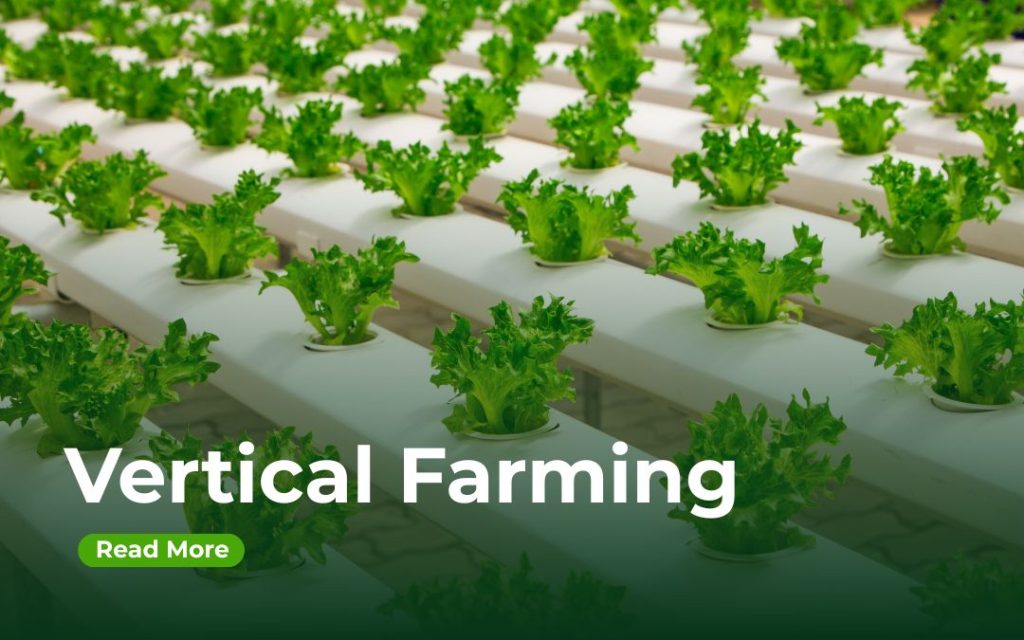
An agricultural method known as “vertical farming” involves growing crops indoors in soilless, vertically stacked layers. The late 20th century saw the emergence of modern vertical farming, which has been promoted as a way to grow food in places that are unsuitable for conventional farming, such as cities. Vertical farming, a type of Controlled Environment Agriculture (CEA), depends entirely on man-made inputs and conditions to give crops the best possible growing conditions.
Dickson Despommier, an environmental science professor, developed the contemporary idea of vertical farming. In 1999, Despommier and a team of his Columbia University graduate students came up with the idea for a multistory structure that could produce more crops on a smaller area than conventional farming practices. “Plants grown in high-rise buildings erected on now vacant city lots and in large, multistory rooftop greenhouses could produce food year-round using significantly less water, producing little waste, with less risk of infectious diseases, and no need for fossil-fueled machinery or transport from distant rural farms,” Despommier later spoke about his vision for vertical farming.

Systems and crops
Modern vertical farms can be located in a broad range of structures, including skyscrapers, warehouses, and shipping containers; smaller arrangements are also employed in farm-to-table restaurants. Vertical farming enterprises use three main soilless methods: hydroponics, aquaponics, and aeroponics. Hydroponic systems cultivate plants by immersing their roots in nutrient solution, with or without the mechanical support of an inert media such as sand, gravel, or perlite.
Aquaponic systems build on hydroponic systems by including fish and nitrifying bacteria in a closed loop system, where the bacteria transform fish waste into a nutrient supply for plants. NASA developed aeroponic technologies in the 1990s to grow plants in air or mist environments.
Given the restricted space available in vertical farming systems, most plants are rather small. Leafy greens, microgreens, herbs, and strawberries are popular and inexpensive options since they grow quickly and use less energy than other crops. Leaf crops are ideal for vertical farming because they may be picked whole, allowing the next crop to be sown, and they do not require pollination, unlike most fruit, vegetable, and seed crops. Cucumbers and tomatoes are examples of vegetable crops that are grown occasionally but not widely. Traditional row crops, such as corn and soybeans, and cereal grains, such as rice and wheat, are not ideal candidates for vertical farming operations.
The Benefits of Vertical Farming
Vertical farming provides numerous advantages, including maximum productivity with low environmental effect and significantly less space required. With limited resources, it will become increasingly difficult to continue producing food using existing ways.
Increased Production All Year
Vertical farming also results in higher total yield and stable year-round output. Some fruits and vegetables are now available year-round, unlike in the past. Vertical farms, on the other hand, may grow a wide range of crops all year long with no reliance on weather or climate.
Utilize Less Water & Space
Vertical farming techniques allow farmers to utilize 98% less water and 99% less land. They may create crop yields that are 240 times higher than those of regular farms by rolling or harvesting crops all year. All of our food is powered by the sun rather than LED lights, so it does not rely on fossil fuels or other less desirable energy sources.
By 2050, over 80 percent of the world’s population will live in cities. This population pattern will result in increased demand for food in locations where land is scarce. Vertical farming in these huge urban areas provides a solution to the rising need for food without the requirement for large farms.
Pesticide-free
CEA vertical farms typically have little need or even use for pesticides. By controlling the environment around crops, these systems keep out pests naturally – no need for chemical pesticides that can cause other problems down the line.