
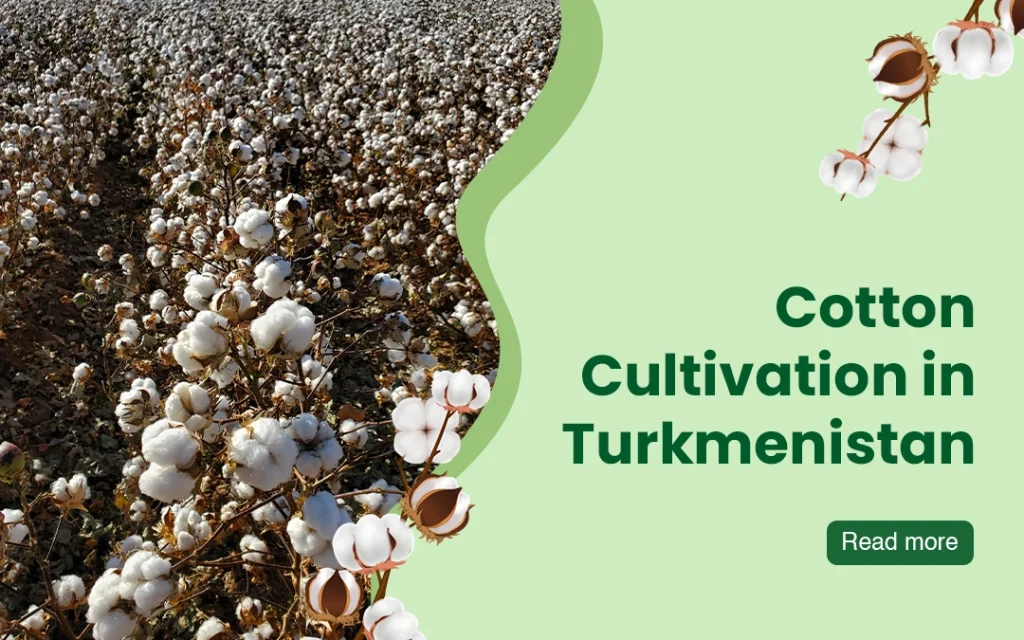
Cotton, often called “white gold” in Turkmenistan, has long been the backbone of the country’s agricultural economy. From the vast irrigated plains of the Amu Darya River to the sun-baked steppes of the Karakum Desert, cotton fields dominate the rural landscape. This crop is not just an export commodity — it’s a part of Turkmenistan’s national identity, a legacy of both tradition and transformation. Cotton, often referred to as “white gold,” has deep historical roots in Central Asia, and in Turkmenistan, it remains one of the country’s most strategically important agricultural products. While it contributes significantly to the national economy and foreign exchange earnings, the story of Turkmen cotton is complex, intertwined with geographical challenges, a centralized state system, and serious human rights concerns.
The Importance of Cotton in Turkmenistan
Cotton is one of Turkmenistan’s most valuable agricultural products and a key export commodity. It contributes significantly to the nation’s GDP and provides employment to a large portion of the rural population. Each year, hundreds of thousands of hectares are planted with cotton, making the country one of the top producers in Central Asia.
Historically, during the Soviet era, Turkmenistan was integrated into the USSR’s cotton production system. Even after independence in 1991, cotton remained central to the country’s economy — symbolizing national pride and agricultural self-sufficiency.
Climate and Soil Conditions
Turkmenistan’s arid and semi-arid climate, with hot summers and mild winters, provides suitable conditions for cotton, which thrives in warm and sunny environments. However, since rainfall is minimal, irrigation is essential for successful cultivation.
Ideal conditions for cotton in Turkmenistan:
- Temperature: 25°C–35°C during the growing season
- Rainfall: Less than 200 mm annually — irrigation is mandatory
- Soil: Alluvial and loamy soils near river basins, rich in minerals and well-drained
- Regions: Major cotton-growing areas include Mary, Lebap, Dashoguz, and Ahal provinces, all benefiting from irrigation canals branching from the Amu Darya River.
Cotton Varieties and Seed Selection
Cotton production in Turkmenistan relies on specialized, high-yield, and heat-resistant upland varieties (mostly Gossypium hirsutum) adapted to arid conditions. Turkmenistan primarily cultivates medium-staple upland cotton (Gossypium hirsutum)—such as Ýolöten-7, Ýolöten-39, Jeýhun, and 149-F—along with fine-staple varieties (e.g., Ýolöten-14) in Akhal and Mary regions. These are chosen for high yield, drought resistance, and fiber quality.In Turkmenistan typically grow upland cotton (Gossypium hirsutum) varieties adapted to local conditions. These varieties are chosen for:
- High yield potential
- Resistance to heat and drought
- Good fiber quality suitable for the textile industry
Government research institutions regularly introduce improved seed varieties through breeding programs aimed at boosting productivity and fiber strength.
Land Preparation and Planting of Cotton in Turkmenistan
Cotton requires well-prepared and leveled land for uniform irrigation and germination. Fields are plowed, often to destroy remnants of previous crops, followed by intensive harrowing to break clods and create a fine seedbed. Proper leveling is crucial for uniform water distribution, especially to avoid waterlogging in some areas. Land preparation involves intensive, mechanized, and state-supported practices, including deep plowing, land leveling, harrowing, and the application of organic/mineral fertilizers, typically done in early spring (Feb/Mar)Farmers
- Land preparation: Fields are plowed, leveled, and ridged before planting to ensure even water distribution.
- Planting time: Seeds are sown between March and April, depending on the region and temperature.
- Planting method: Mechanical seed drills are used for even spacing, usually at a depth of 3–5 cm.
- Irrigation: The first irrigation occurs immediately after planting to ensure germination.
Crop Management Practices of Cotton in Turkmenistan
1. Irrigation
Since natural rainfall is scarce, irrigation from canals — such as the Karakum Canal, one of the world’s largest — plays a vital role. Cotton typically needs 5–7 irrigations during the growing season. Efficient water management is critical to prevent salinization and waterlogging.
2. Fertilization
Cotton depletes soil nutrients rapidly. Farmers apply nitrogen, phosphorus, and potassium fertilizers, usually in split doses to support different growth stages. Organic manure is also encouraged to improve soil structure and fertility.
3. Weed and Pest Control
- Weeds: Controlled through mechanical cultivation and selective herbicides.
- Pests: Common pests include bollworms, aphids, and spider mites. Integrated Pest Management (IPM) practices, such as crop rotation and biological control, are increasingly promoted.
Flowering, Boll Formation, and Harvest of Cotton in Turkmenistan
- Flowering: Begins around 45–60 days after sowing.
- Boll formation: Cotton bolls mature in about 120–150 days.
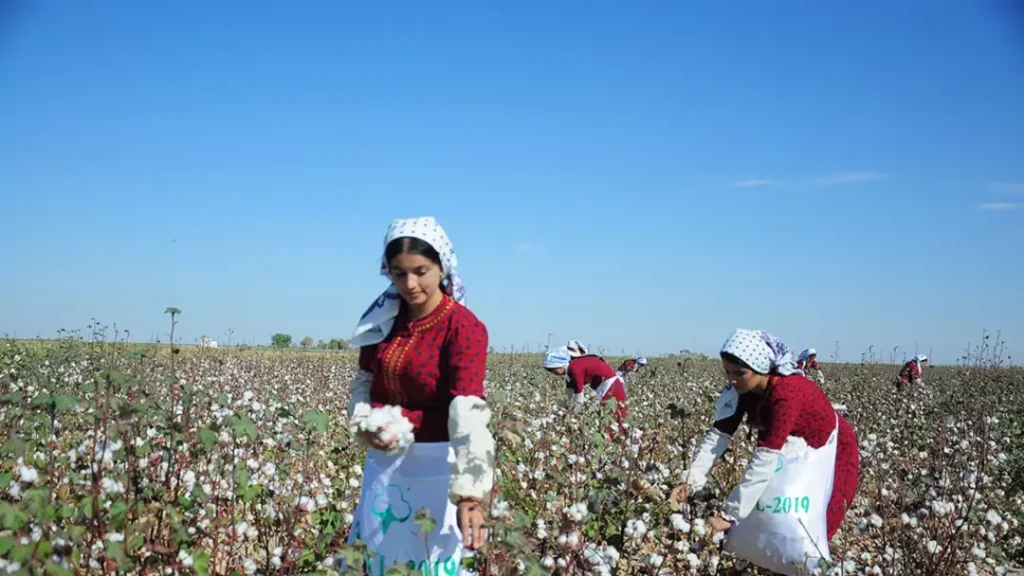
- Harvesting: Usually begins in September and continues through November.
Turkmenistan has invested in mechanized harvesting, but manual picking is still practiced in some areas to reduce fiber damage. Farmers must ensure that cotton is harvested only when bolls are fully open to maximize fiber quality.
Economic and Environmental Considerations
The industry is heavily dependent on the Karakum Canal, which suffers from high, as estimated 28% to 60% of water losses. This inefficient irrigation (typically 5–7 times per season) leads to significant waterlogging and secondary soil salinization. ontinuous monocropping of cotton has reduced soil fertility. Soils in key regions like the Amu Darya basin are heavily saline.
Rising temperatures, droughts, and heat stress negatively impact growth and yields, putting pressure on already scarce water resources.
Chemical Pollution: Excessive use of fertilizers (up to 250 kg/hectare in some areas) and pesticides, with low absorption rates (15–40%), causes significant pollution of soil and groundwater.
Economic Aspects
- Cotton is a major export earner, supporting both the agricultural and industrial sectors.
- It provides employment to thousands of rural workers, particularly during planting and harvesting seasons.
Environmental Challenges
- Water use: Heavy irrigation has led to water shortages and soil salinity, especially near the Amu Darya basin.
- Soil degradation: Continuous cotton monocropping reduces fertility.
- Sustainability efforts: New initiatives encourage drip irrigation, crop rotation, and soil testing to improve long-term sustainability.
Cotton cultivation is deeply embedded in the identity and economy of Turkmenistan. Key varieties include Yoloten-7, Yoloten-39, S-2606, and Yoloten-14. It generates essential revenue, supports a textile industry, and is a significant employer. However, the future of “white gold” is inextricably linked to addressing its most pressing challenges: modernizing irrigation to ensure environmental sustainability, and, most importantly, fulfilling international human rights obligations by eradicating the systemic forced labor that taints its production. Only then can Turkmen cotton truly thrive on the global market without ethical concerns.
Read more blogs on Turkmenistan farming.